Click for details
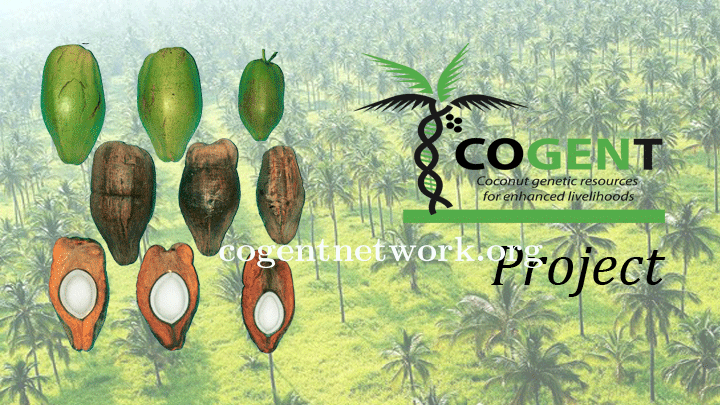
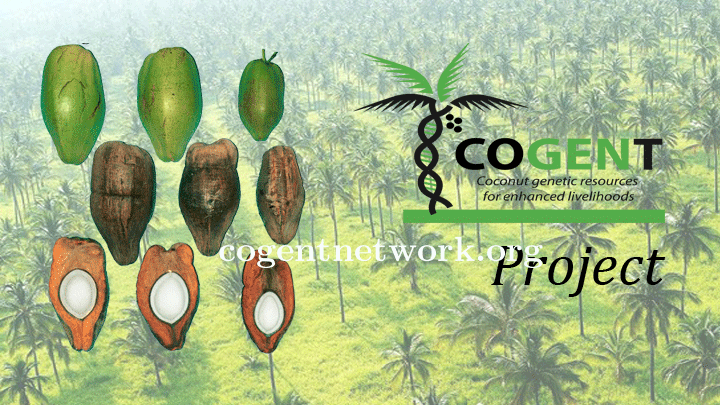
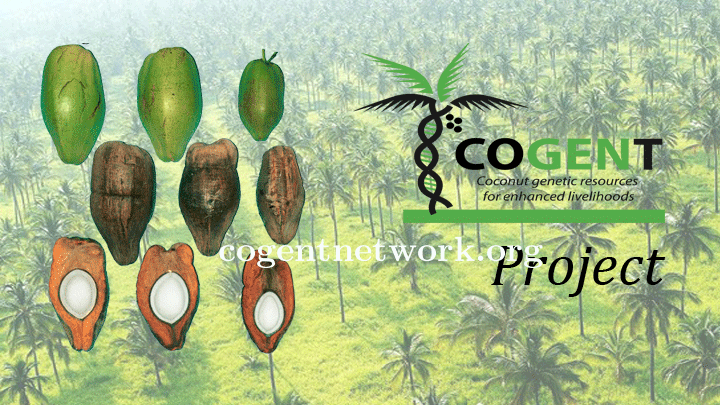
The International Coconut Genetic Resources Network aims to promote collaboration for the conservation and use of coconut genetic resources. COGENT currently is made up of 39 country members: Bangladesh, Benin, Brazil, China, Colombia, Cook Islands, Costa Rica, Côte d'Ivoire, Cuba, Fiji, Ghana, Guyana, Haiti, Honduras, India, Indonesia, Jamaica, Kenya, Kiribati, Madagascar, Malaysia, Mexico, Mozambique, Myanmar, Nigeria, Pakistan, Papua New Guinea, Philippines, Samoa, Seychelles, Solomon Islands, Sri Lanka, Sultanate of Oman, Tanzania, Thailand, Tonga, Trinidad y Tobago, Vanuatu and Viet-nam.
Only a country can become a COGENT member. Each country member is represented in COGENT by a national representative, chosen by the country concerned. Two regional coordinators from each of the five regional networks, namely: South Asia and Middle East, Southeast and East Asia, the South Pacific, Africa and the Indian Ocean, and Latin America and the Caribbean, constitute the Steering Committee. The COGENT Coordinator is an ex-officio member and serves as the Secretary.
Any coconut-producing country can become a member. COGENT currently has 39 member countries that are divided into five sub-networks: Southeast and East Asia (China, Indonesia, Malaysia, Myanmar, Philippines, Thailand and Vietnam); South Asia and Middle East (Bangladesh, India, Pakistan, Sultanate of Oman and Sri Lanka); South Pacific (Cook Islands, Fiji, Kiribati, Papua New Guinea, Samoa, Solomon Islands, Tonga and Vanuatu); Africa and the Indian Ocean (Benin, Côte d’Ivoire, Ghana, Kenya, Madagascar, Mozambique, Nigeria, Seychelles and Tanzania); and Latin America and the Caribbean (Brazil, Colombia, Costa Rica, Cuba, Guyana, Haiti, Honduras, Jamaica, Mexico and Trinidad-Tobago)
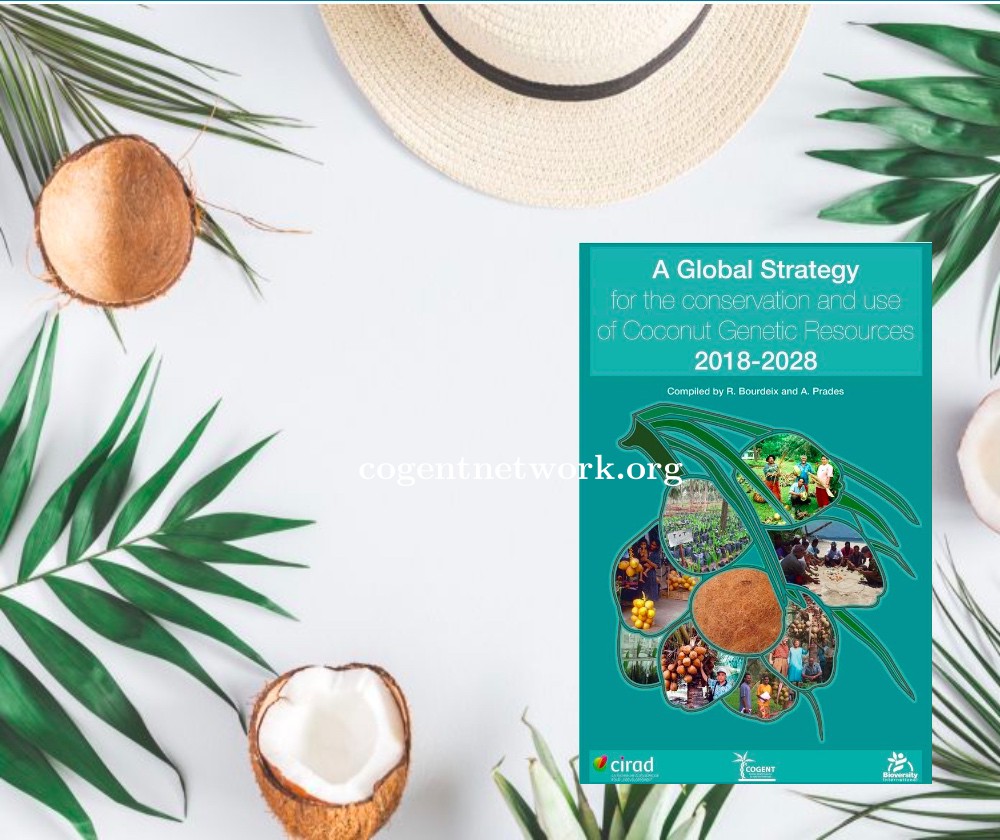
This Global Strategy for Conservation and Use of Coconut Genetic Resources has been compiled by Dr Roland Bourdeix and Dr Alexia Prades of CIRAD, (formal launch at the APCC 48th COCOTECH meeting in Bangkok 20-24 August 2018). An implementation plan will be discussed at a COGENT side-meeting 25-26 August. COGENT embraces 39 coconut-producing member-countries, representing more than 98% global production. COGENT aims to strengthen international collaboration in conservation and use of coconut genetic resources; promote improving coconut production, and boost linked livelihoods
COGENT has (re-)established four International Thematic Action Groups (ITAGs) to lead in the identification and coordination of priority projects for germplasm conservation and use, linked to implementing COGENT’s Global Strategy for the Conservation and Use of Coconut Genetic Resources.
Ex-situ conservation is the preservation of components of biological diversity outside their natural habitats. This involves conservation of genetic resources, as well as wild and cultivated or species, and draws on a diverse body of techniques and facilities.
In-situ conservation, the conservation of species in their natural habitats, is considered the most appropriate way of conserving biodiversity
Details to be advised
Africa is the world's second-largest and second-most populous continent, after Asia in both cases. At about 30.3 million km² including adjacent islands, it covers 6% of Earth's total surface area and 20% of its land area. With 1.3 billion people as of 2018, it accounts for about 16% of the world's human population.
The Indian Ocean is the third-largest of the world's oceanic divisions, covering 70,560,000 km2 (27,240,000 sq mi) or 19.8% of the water on Earth's surface. It is bounded by Asia to the north, Africa to the west and Australia to the east.
The term Latin America and the Caribbean (LAC) is an English-language acronym referring to the Caribbean and Latin America region. The term LAC covers an extensive region, extending from The Bahamas and Mexico to Argentina and Chile. The region consists over 670,230,000 people as of 2016, and spanned for 21,951,000 square kilometres (8,475,000 sq mi).
Located between trading routes connecting Western and Eastern nations and in close proximity to Europe, Africa and India, the South Asia & Middle East region has for centuries been and continues to be a hub for global and regional trade.
The South Pacific is big place - incredibly vast and blue, covering 11 million square miles stretching from the top of Australia to the Hawaiian Islands. Celebrated by artists and writers, from Paul Gauguin to James Michener, these thousands of tiny coral and volcanic-stone dots are home to fascinating peoples and cultures. Some islands - such as Tahiti and Fiji - are well known, while others not so much. You get a gold star if you've even heard of Aitutaki or Yap.
Southeast Asia or Southeastern Asia is the southeastern region of Asia, consisting of the regions that are geographically south of China, east of the Indian subcontinent and north-west of Australia. Southeast Asia is bordered to the north by East Asia, to the west by South Asia and the Bay of Bengal, to the east by Oceania and the Pacific Ocean, and to the south by Australia and the Indian Ocean.
Regular Meetings is held every month.
Meeting goes virtually in Pandemic Situation of Corona Virus
Here are some key research ideas that the Cogent network would like to develop into projects in the very near future. These research ideas are authored and dated. Any suggestions are welcome.
Members, please do not hesitate to submit new research ideas!
Donors, do not hesitate to contact us if you are interested to fund one of these research ideas !
No Ongoing Projects recently
8th Floor BAPPEBTI Building Jl. Kramat Raya No. 172
Kenari, Senen, Jakarta, Indonesia 10430
Phone +62 21 3100556-557
Fax +62 21 3101007
Email:
Secretariat : icc@coconutcommunity.org
Cogent Coordinator : v.johnson@coconutcommunity.org
There are more thank 60 representatives spread of all the world.
For more lists, please see the link below.
More thank 100 associate experts joined in COGENT.
For more list see the the below.
See All Videos



 United States